
Tire Maintenance and Longevity for Electric Vehicles
Introduction
Have you ever wondered why electric vehicle tires wear out faster than those on gasoline cars? Don’t blame the rubber quality or road conditions. The real culprit is simpler: EVs aren’t just “cars with a plug.” The battery’s weight, instant torque, and even your driving habits quietly chew through tread.
This article skips the jargon and scare tactics. Instead, we’ll share practical tips to extend your tire life without breaking the bank. We’ll debunk myths (“Winter tires? Why bother? I have ‘Snow Mode’!”), explain why TPMS isn’t always reliable, and reveal how everyday choices — like skipping tire rotations — cost you hundreds of kilometers in range.
Tire Pressure and Monitoring — How Hidden Mistakes Shorten Your Electric Vehicle’s Lifespan
At first glance, maintaining proper tire pressure seems simple. But for electric vehicles (EVs), it becomes a puzzle with a dozen variables. Take the myth of even tire wear. “Pressure is correct? Then the tires wear evenly” — many drivers assume this. However, AutoBild tests reveal a different truth: even at the ideal 3.0 bar, rear tires on EVs wear out 40% faster. The reason lies in the instant torque of electric motors, which literally “tears” the rubber during acceleration. Engineers still debate solutions: some insist on rotating tires every 8,000 km, while others argue it’s pointless for all-wheel-drive models. But all agree: monitoring pressure shouldn’t be an occasional ritual — it’s a constant necessity.
This raises another issue: how reliable are electronic monitoring systems? TPMS (Tire Pressure Monitoring Systems), those “smart guardians,” sometimes act like capricious oracles. A TÜV study found that in 12% of cases, sensors err by ±0.2 bar — a critical margin for handling a heavy EV. The cause isn’t mythical “electromagnetic interference” but mundane sensor aging or sudden temperature swings. Manufacturers swear by their systems’ reliability, yet NHTSA data delivers a reality check: in half of tire-related accidents, TPMS remained silent. The conclusion is clear: Even if the dashboard says “all good,” check pressure manually with a mechanical gauge every two weeks.
But what if you cheat a little? “Overinflate tires by 0.3 bar — get 35% longer tread life!” forum enthusiasts claim. NHTSA data confirms: overinflation does reduce wear by a third. But the trade-off is stark: aquaplaning risk on wet roads jumps by 25%. It’s a tightrope walk — engineers are split. Some call it a rational compromise for extra range; others liken it to Russian roulette. Notably, brands like Tesla and BMW avoid explicit recommendations, sticking to dry numbers on the doorjamb sticker. Do they know something they’re not sharing?
Winter complicates this puzzle further. “Why adjust pressure? The battery’s weight ensures grip,” some drivers argue. ADAC shatters this myth: at -10°C, pressure drops by 0.1 bar, slashing range by 20% and accelerating tread wear. Meanwhile, TPMS can’t always keep up — it relies on stability that winter’s temperature swings disrupt. Norwegian EV veterans have a fix: they add 0.1–0.2 bar in freezing weather but vigilantly avoid crossing the line between safety and a bone-rattling ride.
So, where is that elusive balance? The interplay between pressure, safety, and efficiency is more nuanced than it seems. Below is a breakdown of what you gain — and lose — at different pressure levels, based on real-world data from ADAC, NHTSA, and AutoBild. Let the numbers guide your choices, but remember: no table can replace common sense."
| Parameter | Low Pressure (-0.3 bar) | Recommended Pressure | High Pressure (+0.3 bar) |
|---|---|---|---|
| Tire Wear | +30% | Normal | -35% |
| Range | -25% | 100% | +8% |
| Aquaplaning Risk | +15% | Normal | +25% |
| Regenerative Efficiency | -20% | 100% | +5% |
| TPMS Reliability | High risk of false readings | Optimal accuracy | Increased sensor errors |
Tire Rotation and Balancing — How Hidden Mistakes Drain Your Range
Let’s tackle one of the most hotly debated topics in EV maintenance today — Tire Rotation and Balancing — where even seasoned drivers argue: ‘Rotation is outdated tech!’
Imagine driving your electric vehicle, confident that the massive battery beneath you ensures even tire wear. But statistics are brutal realists. 45% of EV drivers believe modern tires don’t need rotation, claiming the weight distribution is flawless. Another 30% avoid rotating wheels, fearing it will “break” the range estimation algorithms. These myths shatter against ADAC data: even with balanced weight distribution, rear tires wear 25% faster. The culprit isn’t weight but driving dynamics: every acceleration jerk forces the motor to “rip” the rubber. Engineers debate only the details: Tesla recommends rotation every 10,000 km, while Audi advises waiting for visible imbalance. But the core truth remains — without rotation, you risk being stranded mid-season with suddenly bald tires.
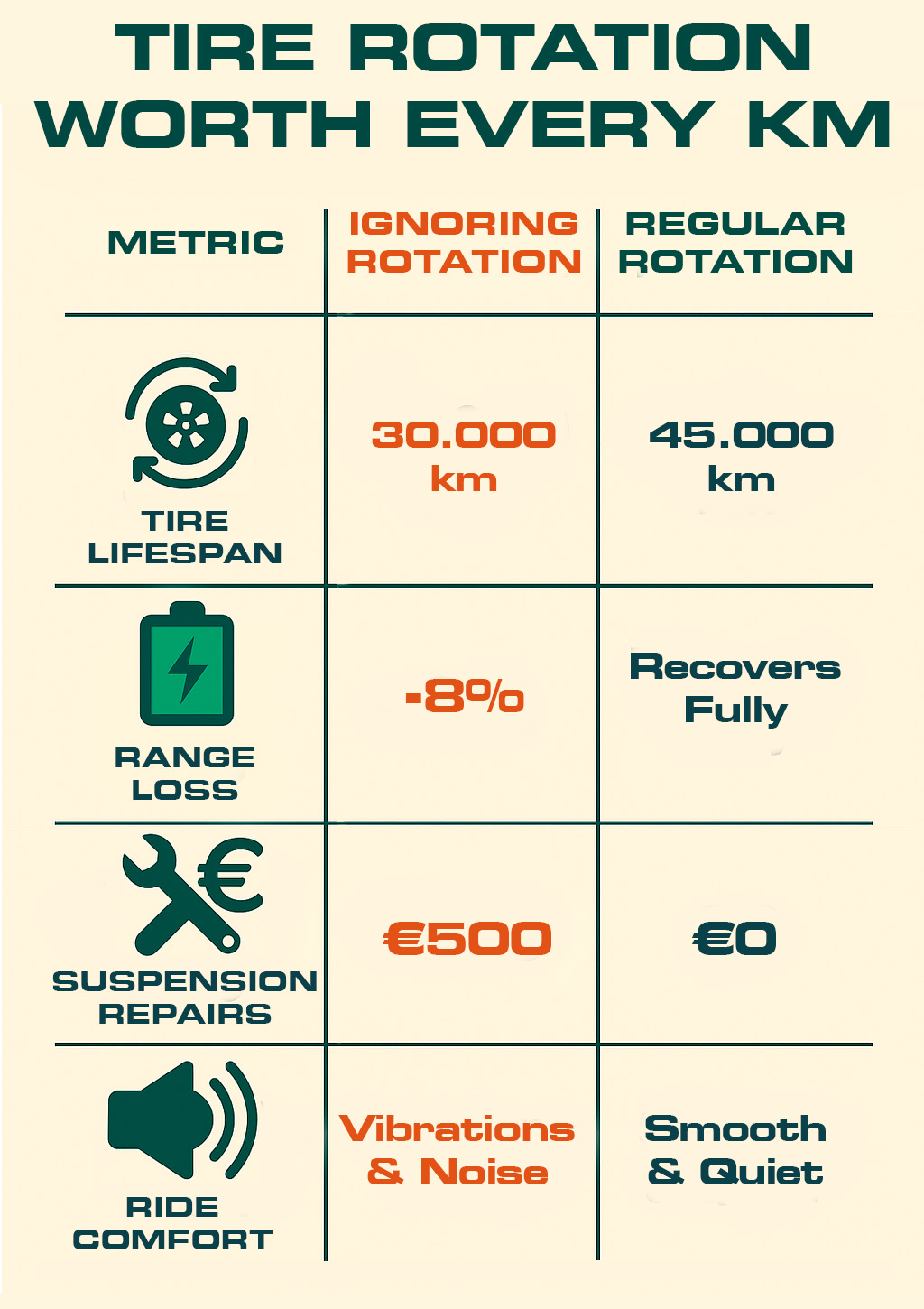
Yet uneven wear is just the tip of the iceberg. The real range saboteur hides in the details — balancing weights. Twenty grams on the rim seems trivial. But NHTSA found these tiny weights cause 7% of TPMS “glitches.” Imbalance triggers tire vibrations, confusing sensors and making pressure “jump.” The dashboard shows green, but the tire has already lost 0.2 bar — a 5% range drop. Manufacturers stay silent, but Munich workshops now use anti-magnetic weights. “It’s like trying to hear a whisper in a subway — that’s how TPMS battles imbalance interference,” explains a TÜV engineer.
The most dangerous myth thrives in garages: “EVs don’t need rotation — the battery compensates.” Let’s dissect it using the Tesla Model 3. Even with balanced weight, rear tires lose 1.5 mm more tread than fronts. Why? Regenerative braking “yanks” the rear axle like an anchor mid-speed. Norwegian drivers found a fix: after rotation, they activate calibration mode by driving 50 km on highways. Within three days, range rebounds to normal. This proves the fear of “messing with algorithms” is an illusion. The real enemy is rolling resistance, which spikes by 8% on worn tires.
Driving Habits — The Silent Enemies of Your EV’s Tires and Range
You press the accelerator, feeling the electric motor silently propel the car forward. It seems such smooth acceleration couldn’t possibly harm the tires — no engine roar, no vibrations. But ADAC statistics shatter this illusion: every aggressive "Sport" mode acceleration reduces rear tire lifespan by 30%. These aren’t abstract numbers — they represent micro-tears in the rubber under the strain of instant torque. While engineers debate software power limits, 70% of drivers ignore recommendations, dismissing them as "unnecessary advice." Why? The answer lies in myths disguised as common sense.
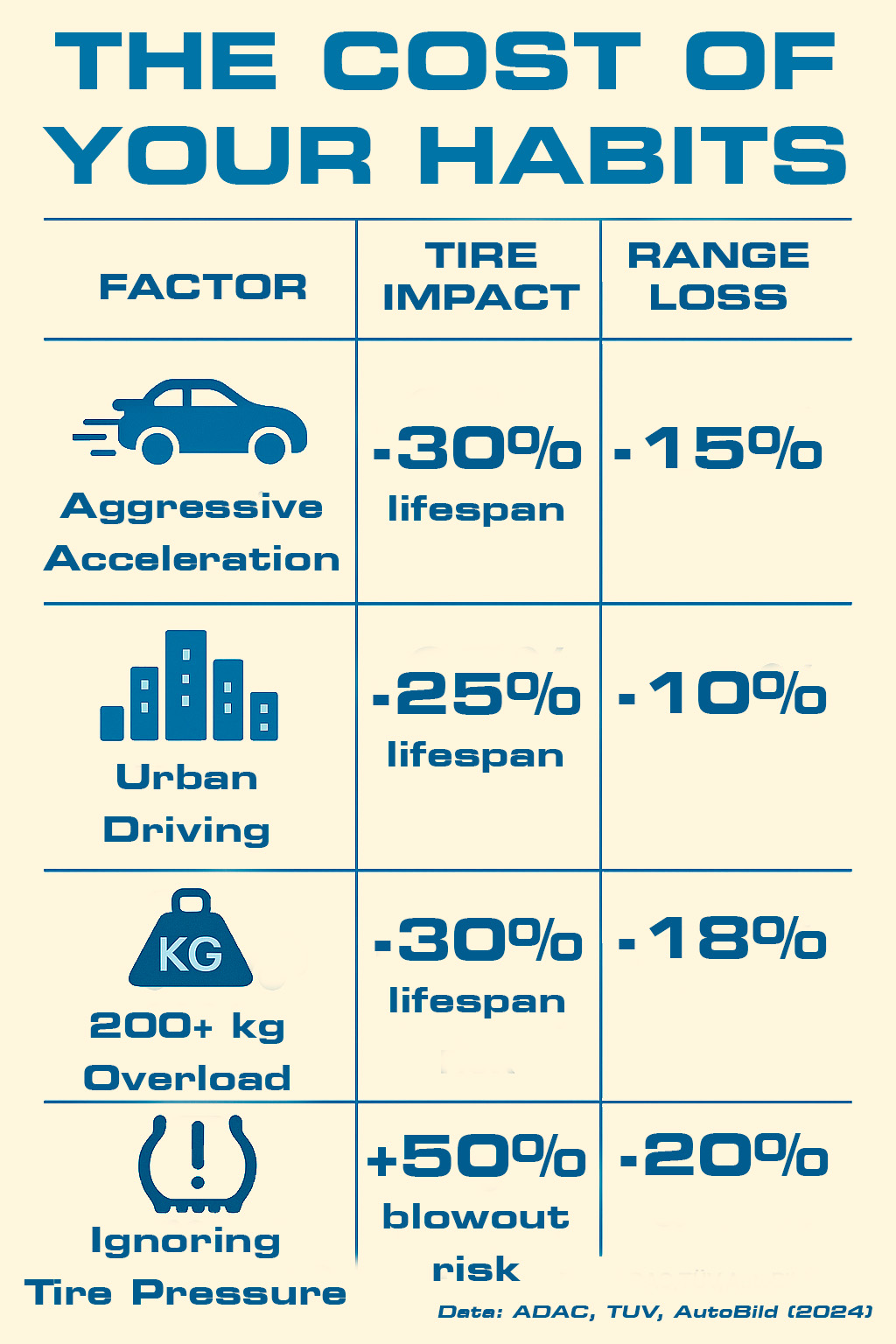
One such myth offers false comfort: "Gentle driving extends tire life." Yes, smooth starts and avoiding hard braking reduce stress. But city traffic turns even cautious driving into a tire endurance test. Traffic lights, jams, constant micro-accelerations — all create friction that heats and deforms tires. TÜV research reveals: urban driving wears EV tires 25% faster than highway cruising. The culprit isn’t driving style but the battery’s weight — that "anchor" beneath the floor, pressing down on tires even in "Eco" mode. BMW and Tesla engineers still argue solutions: limit power or reformulate rubber. For now, the only fix is measuring tread depth every 5,000 km and ignoring fairy tales about "indestructible tires."
These tales turn dangerous when drivers overload their cars, believing "the battery can handle any weight." Yes, the platform supports 500 kg, but tires don’t. AutoBild tests proved: a 200 kg overload (5 passengers + luggage) increases tire wear by 30% and slashes range by 18%. Imagine wearing a backpack of bricks and wondering why sneakers wear out in a month. EV tires are those sneakers — they crumple, overheat, lose shape. Ignore load limits, and you’ll soon hear bearing knocks or feel steering wheel vibrations.
Storage and Seasonal Changes: How Hidden Mistakes Turn Tires into Disposable Parts
You park your car in the garage, convinced that the battery’s weight will protect your all-season tires. “Why bother with winter tires? The car’s heavy enough!” — you reason. But ice doesn’t care about weight — it demands grip. In Norway, where 80% of EVs switch to winter tires, winter accident rates dropped by 25%. The reason is simple: winter tires grip ice with thousands of micro-pores, while all-seasons slide like skates. Even Tesla’s “Snow Mode” is just software — it can’t override physics. Yet owners argue: “I save €800 a year!”. The truth? That “savings” could cost €2000 in suspension repairs after hitting a snowbank.
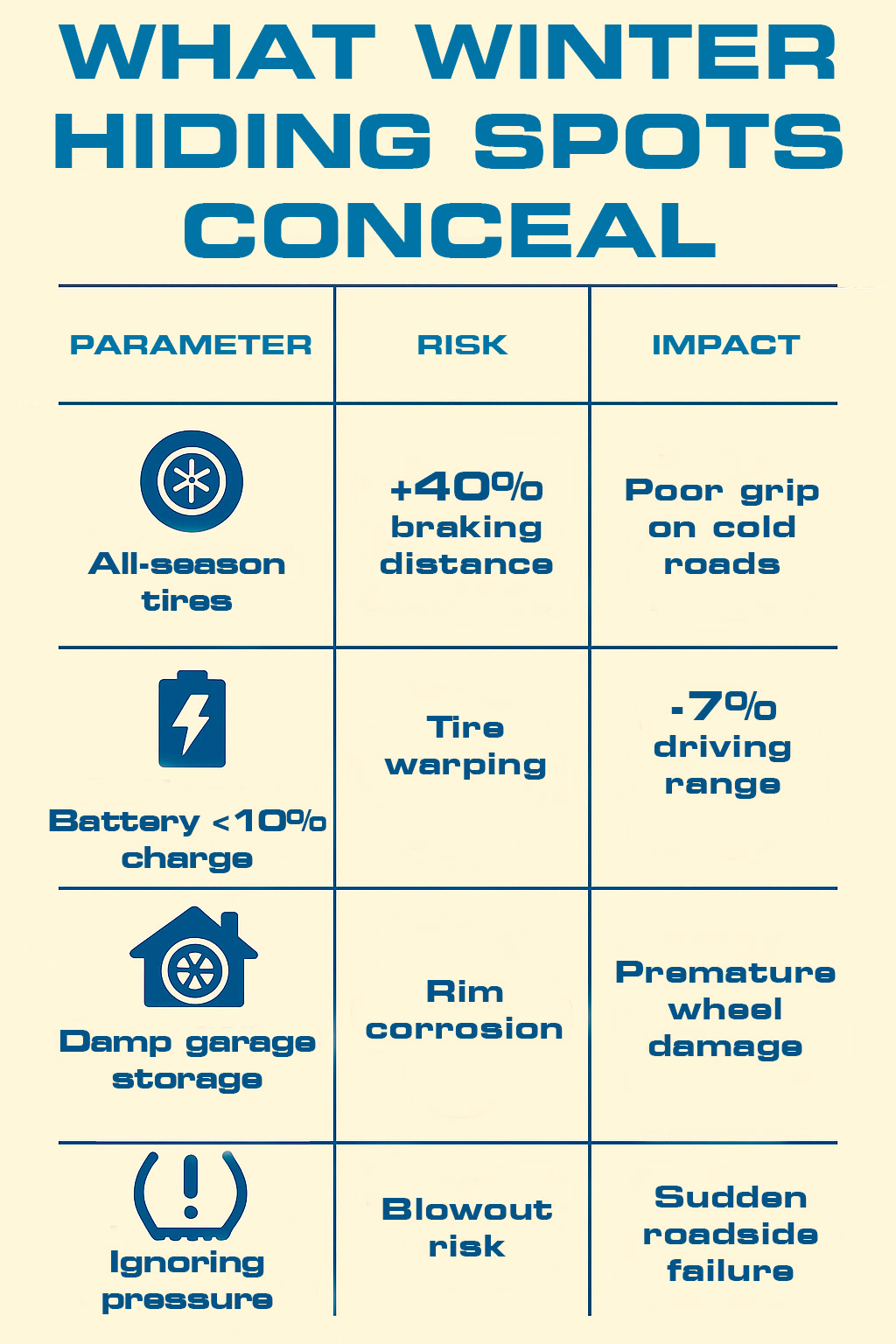
Meanwhile, in the garage where your car sits for a month, a silent disaster unfolds. “Battery at 5%? I’ll charge it in spring.” But below 10% charge, tire pressure drops by 0.3 bar — TPMS shuts off, and tires begin to warp. By spring, they’ll resemble figure-eights, and range will drop by 7%. Tesla engineers advise keeping charge at 50–70%, but drivers fear “overcharging” as if the battery were a cup about to overflow. The paradox: fear of a myth kills tires faster than real charging cycles.
Your garage feels safe — dry, draft-free. “Tires are protected from moisture!” — you think. But dampness isn’t just water. Condensation coats rims, while road salt and chemicals brew a corrosive “cocktail.” 25% of EVs stored this way develop rust spots on rims by spring. Tires suffer too: grime acts like sandpaper, eroding protective layers. AutoBild tested washed vs. dirty tires — cleaned ones lost 15% elasticity, dirty ones 30%. It’s like leaving a wound uncovered and wondering why it festers.
The deadliest enemy is overconfidence: “The tire inflation system handles everything.” Yes, it compensates 0.1 bar/month, but at -20°C, pressure drops 0.4 bar. By spring, tires reach critical lows, and you’d never guess they’re near rupture. In Sweden, where frost is routine, 20% of tire blowouts happen post-hibernation. “The system’s a crutch, not a fix,” mechanics say. They’re right: no tech replaces human vigilance.
FAQs
Most frequently asked questions about tire maintenance and longevity for electric vehicles:
- Q: Is nitrogen inflation better than regular air for EV tires?
A: Using nitrogen can slightly reduce pressure loss over time because nitrogen molecules are larger and leak out slower than oxygen. For EV owners aiming to maximize range and tire life, nitrogen inflation can offer a marginal benefit — but consistent monthly pressure checks remain far more important than the inflation gas used. - Q: Can adjusting driving modes (Eco, Sport, etc.) actually help preserve tire life?
A: Yes. Driving in Eco or Comfort modes often moderates torque delivery and throttle response, leading to smoother acceleration and braking. Over time, this gentler driving style can significantly extend tire life by reducing the mechanical stresses that cause accelerated tread wear. - Q: Does frequent use of one-pedal driving in EVs impact tire wear?
A: Yes. One-pedal driving, which uses regenerative braking to slow down the car, can concentrate wear on the drive axle tires. While it reduces brake pad wear, it still stresses tires during deceleration. Rotating tires more often can help balance this uneven wear pattern. - Q: Are run-flat tires a good idea for electric vehicles?
A: Run-flat tires offer extra convenience by allowing limited driving after a puncture. However, they are often heavier and stiffer, which can slightly reduce EV range and ride comfort. EV owners should weigh convenience against efficiency needs when considering them. - Q: Can regenerative braking increase uneven tire wear if not properly managed?
A: Yes. If regenerative braking strength is set too high without adjusting driving style, it can cause uneven wear on the drive axle tires, especially during frequent stop-and-go driving. Moderating regen settings and balancing tire rotation intervals can help minimize this effect.
Conclusion
Taking care of your EV’s tires isn’t rocket science. Here’s the no-nonsense summary:
-
Winter tires aren’t optional. Even the smartest software can’t rewrite physics.
-
TPMS sensors lie sometimes. Check pressure manually every two weeks — it takes 3 minutes.
-
Rotate tires religiously. It’s not a “grandpa’s tip” — it saves €300-500 on replacements.
Store your car in a dry place, avoid overloading the trunk, and your tires will last 20-30% longer. If you think “it’ll do,” remember: every skipped check isn’t just a safety risk — it’s cash tossed out the window.
Your tires aren’t out to get you. They’re just asking for a little attention.
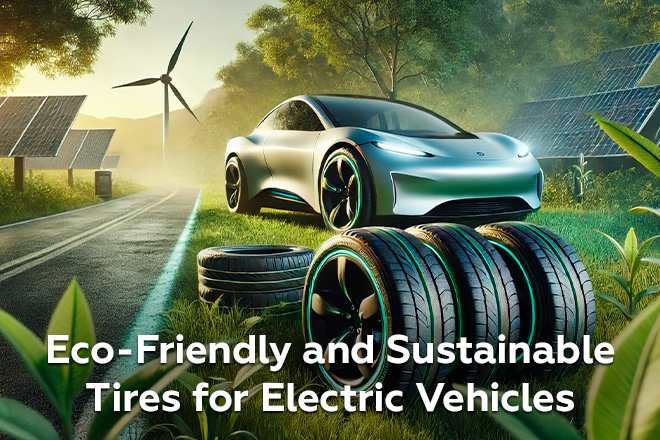
Eco-Friendly and Sustainable Tires for Electric Vehicles
Eco tires: Avoid greenwashing. Learn key certifications, CO2 savings, and top sustainable picks for informed, eco-conscious choices.
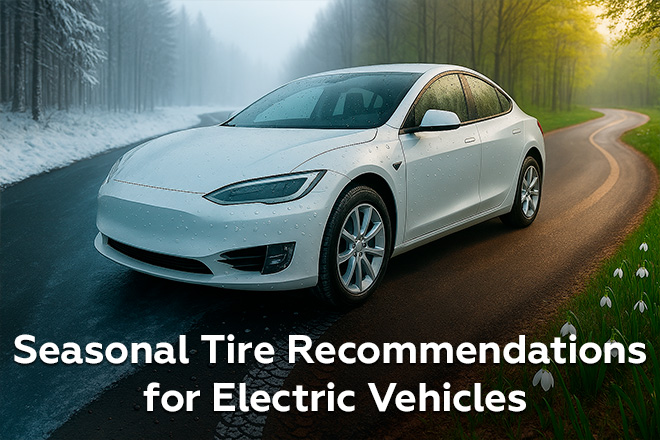
Seasonal Tire Recommendations for Electric Vehicles
EV tire guide: Winter vs summer vs all-season tires compared. Avoid 15% range loss, ensure safety, and optimize performance. Expert advice.
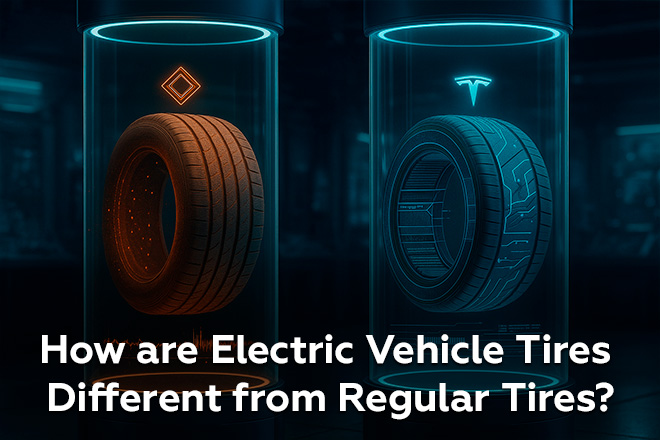
How are Electric Vehicle Tires Different from Regular Tires?
Lose 15% EV range with regular tires? EV-specific tires boost efficiency, reduce noise, handle torque. Essential guide for EV owners.
Original Equipment Tires for Electric Cars
EV tires matter: OE models like Michelin Pilot Sport 4S boost range, cut noise, and handle torque. Avoid 25km range loss and safety risks—see why.
How to Choose Tires for Noise Level and Comfort in EVs
EV tires: Acoustic foam, tread design & ISO tests reduce noise. Choose quiet, comfortable options for your electric vehicle. Expert insights inside.